As tennis players, we can agree that probably the best tennis partner is the mighty wall. This emotionless partner never misses and will force you to hit the ball again and again until it drains your energy. And although there are many advantages of hitting against the wall, there are certain aspects of your tennis game you are better off practicing on the court with a real person.
Advantages:
1. High-quality stroke repetitions (Proper Technique).
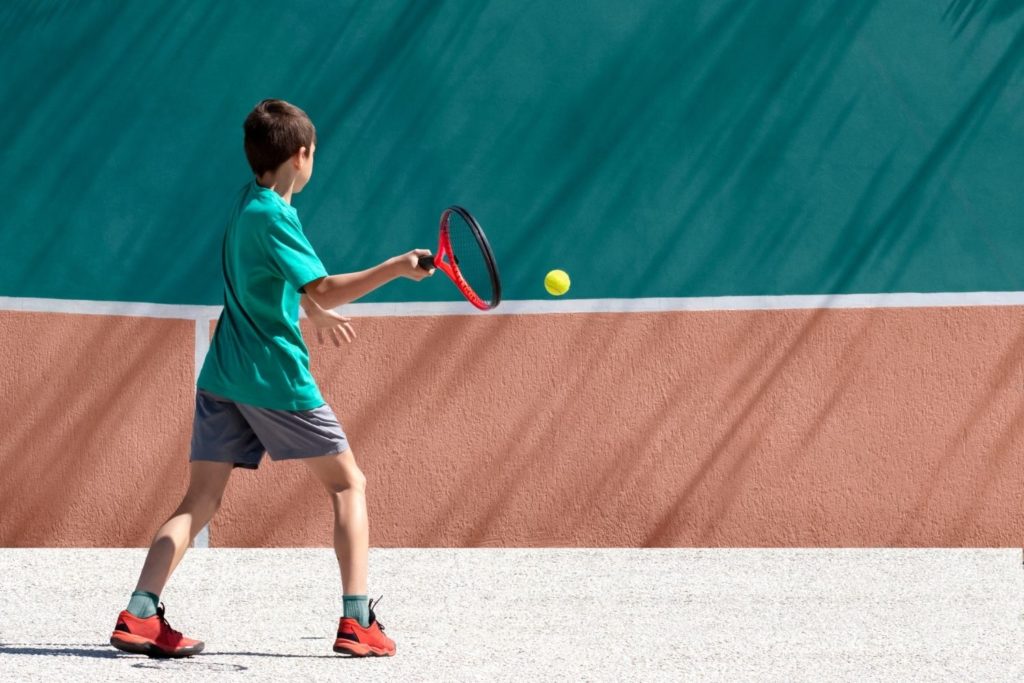
Hitting against the wall allows you to work on technique and proper form. Since you are in control of your training session, you can choose to work on a specific stroke for the time you see necessary.
When looking to improve your technique, it’s recommended that you hit the ball on the second bounce, so you get a more realistic time between shots that allows you to set up correctly.
2. Improves muscle memory.
Since you are able to work on proper technique consistently, eventually you’ll develop better muscle memory and habits on your strokes. This is another significant advantage of hitting against the wall because, as we know, proper muscle memory is critical to be a good tennis player.
3. Improves consistency & control.
When practicing against the wall, it requires you to be consistent with your shots. There are different drills you can work on the wall that require substantial control and consistency.
For example, a consistency drill can be:
– Hitting a forehand down the line (straight)
– Hitting a forehand crosscourt
– Hitting a backhand down the line (straight)
– Hitting a backhand crosscourt Repeat
Another drill is to, simply, hit the ball, so it comes back at you, which seems easy, however, it requires a lot of concentration and control.
4. Practice footwork.
If you’re looking to work on your footwork while hitting balls, as an alternative to doing off court exercises, hitting against the wall can be a great option.
Since the time between shots is less than when hitting on the court, it forces you to move and set up faster, so you can meet the ball on time. In fact, if done properly, hitting, for the same amount of time, against the wall can be more exhausting and intense the hitting on the court with a partner.
5. Improve timing.
Giving that it provides you with constant stroke repetitions, hitting against the wall will help you to improve your sense of timing when contacting the ball. As a result, you’ll be able to hit smoothly and with more precision.
Also, if you had a long break from tennis, hitting on the wall is a great way to get your timing back and get you ready for the tennis court.
6. Helps improve decision-making skills.
One of the main objectives when hitting against the wall is to keep the rally going. As a result, this forces players to make quick decisions to control and place the ball. Players need to think about where they’ll hit the ball, so it bounces back close to them; otherwise, they’ll be chasing the ball all over the place.
7. Improve reflexes.
Working the wall is a great way to improve your reaction time and reflexes, which as tennis players, is an essential skill to have on the court.
A way to work on your reflexes is by getting close to the wall (around 5 to 7 feet) and practice your volleys. Given that the ball will come back fast, it’ll force you to react quicker, developing better reflexes over time.
8. Affordability.
As you probably know tennis can be an expensive sport, from club membership fees to the cost of private lessons. So the wall is an excellent way to practice your tennis game while keeping your costs low. In fact, you can literally practice against the wall for free, you just need to find a wall that you can practice on. For example, the side wall of a building or a house, or even your garage wall.
9. Can practice every stroke.
When practicing against the wall, you can literally work on every stroke, from regular groundstrokes to overheads. Unlike when hitting against someone, when hitting against the wall, you can practice on a specific stroke for the time you see appropriate.
So, if your volleys are one your weakness, you can practice just volleys. As a result, you have the chance to improve your game in different areas and become an all-around player. In addition, you can experiment with new strokes, grips, and technique.
10. No need for a partner.
Have you ever seen those boards at the tennis clubs, where players post notes looking for someone to hit with? As you probably know, it’s not easy to find a tennis partner who has a similar level as your with a coinciding schedule.
Now, we the help of the internet, it’s much easier to find a partner to hit with; however, you still depend on another person to play tennis. On the other hand, when hitting against the wall, you can literally do it whenever you feel like, without worrying about finding a partner.
11. No need for a court.
Although many backboards are next to tennis courts, you can use any wall that has enough space and room around. For example, the sidewalls of a building, house, or parking lot. Also, I know of people who use an empty room to hit against the wall.
If you live in cold areas, you know how expensive and inconvenient can be to book an indoor court. As a result, having the option to practice your tennis game without the need of a court, is a significant advantage.
12. Can be used for warm-up.
Hitting against the wall is, also, great to warm up before your tennis match. Since you can practice every stroke, you can have full warm up of your game, including your footwork.